
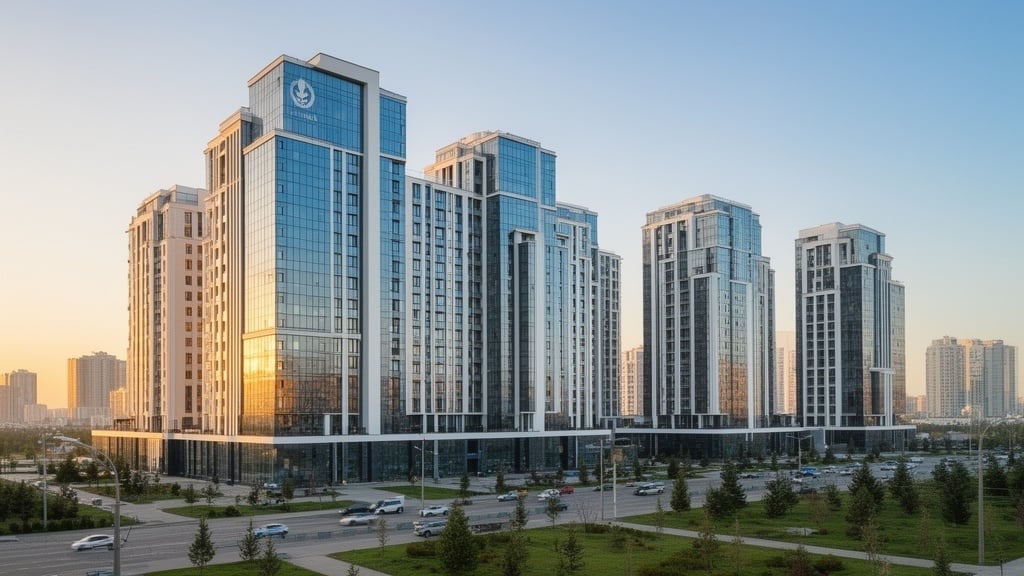
Where Baikonur Is
Baikonur is a district on Astana's right bank, formed in 2018. To the south it is bounded by the right banks of the Esil (Ishim) and Akbulak rivers. It covers 18,129 ha and combines urban quarters with residential areas.
In 2026 the city administration proposed transferring 61 ha of Almaty district to Baikonur, raising its area to 18,190 ha. Under the draft, the district will officially include the Koyandy dacha area (443.9 ha), the city cemetery (460 ha) and the Zharyq LLP territory (384.6 ha). Property documents remain valid when boundaries change.
Apartment Prices in Baikonur
| Apartment | Resale (median) | New builds (average) |
|---|---|---|
| One-room | KZT 18.9m | KZT 34.88m* |
| Two-room | KZT 26.5m | KZT 29.75m |
| Three-room | KZT 40m | KZT 49.57m |
| Four rooms and more | — | KZT 66.07m |
Resale — Krisha.kz median asking price (2026); new builds — Homsters, August 2026. *The average one-room price exceeds the two-room price because of the supply mix — do not use it as a benchmark.
On the resale market Baikonur is Astana's second most affordable district after Saryarka. Two- and three-room new-build apartments here are also cheaper than in most left-bank districts. All districts are compared in the Astana price index.
What Kind of District It Is
- A "city + residential areas" balance: the district has both urban quarters with apartment blocks and private-housing areas.
- The right bank is developing: the master plan provides for renovating some older right-bank neighborhoods and private housing (Homsters, 31.08.2026).
- Transport: the first LRT line runs along the left bank and through Sarayshyk; how the banks differ: "Astana's Left and Right Banks".
Who Baikonur Suits
- Budget buyers — resale here is among the cheapest in the city (district comparison).
- Buy-to-let investors ready to choose the building and neighborhood carefully: a low entry price raises gross yield, but demand varies across the district.
- What to consider: check the building's condition and documents, and for new builds the permit to raise buyers' funds (how to check).
Rents: Benchmarks
There are no official rent statistics by district. The Astana average is KZT 6,079 per m² per month (BNS, August 2026), and the median one-room rent in August 2026 was about KZT 240,000 (Krisha.kz). Compared with the median one-room price in Baikonur (KZT 18.9m), these averages suggest a gross yield above the city average — but the actual rent depends on the specific apartment.
A detailed yield calculation is in our rental business guide.
Frequently Asked Questions
When was Baikonur district of Astana formed?
In 2018. To the south the district is bounded by the right banks of the Esil and Akbulak rivers.
How much does an apartment in Baikonur cost?
On the resale market the median one-room apartment costs about KZT 18.9 million, two-room KZT 26.5 million and three-room KZT 40 million (Krisha.kz, 2026).
Are Baikonur's boundaries changing?
In 2026 the city administration proposed transferring 61 ha of Almaty district to it; the area will grow to 18,190 ha and officially include the Koyandy dacha area, the city cemetery and the Zharyq LLP territory.
Which bank is Baikonur on?
On the right bank of the Esil River, together with Saryarka, Almaty district and Sarayshyk.
Sources
- Wikipedia: Baikonur district (in Russian) — ru.wikipedia.org
- Rimo.kz, 26.01.2026: Astana districts (in Russian) — rimo.kz
- Krisha.kz: Astana district boundaries to change (in Russian) — krisha.kz
- Krisha.kz: where the cheapest apartments in Astana are (in Russian) — krisha.kz
- Homsters: Astana new-build market, August 2026 (in Russian) — info.homsters.kz
- Homsters, 31.08.2026: Astana development (in Russian) — info.homsters.kz
- Inform.kz, 09.07.2026: housing and rent prices per BNS (in Russian) — inform.kz